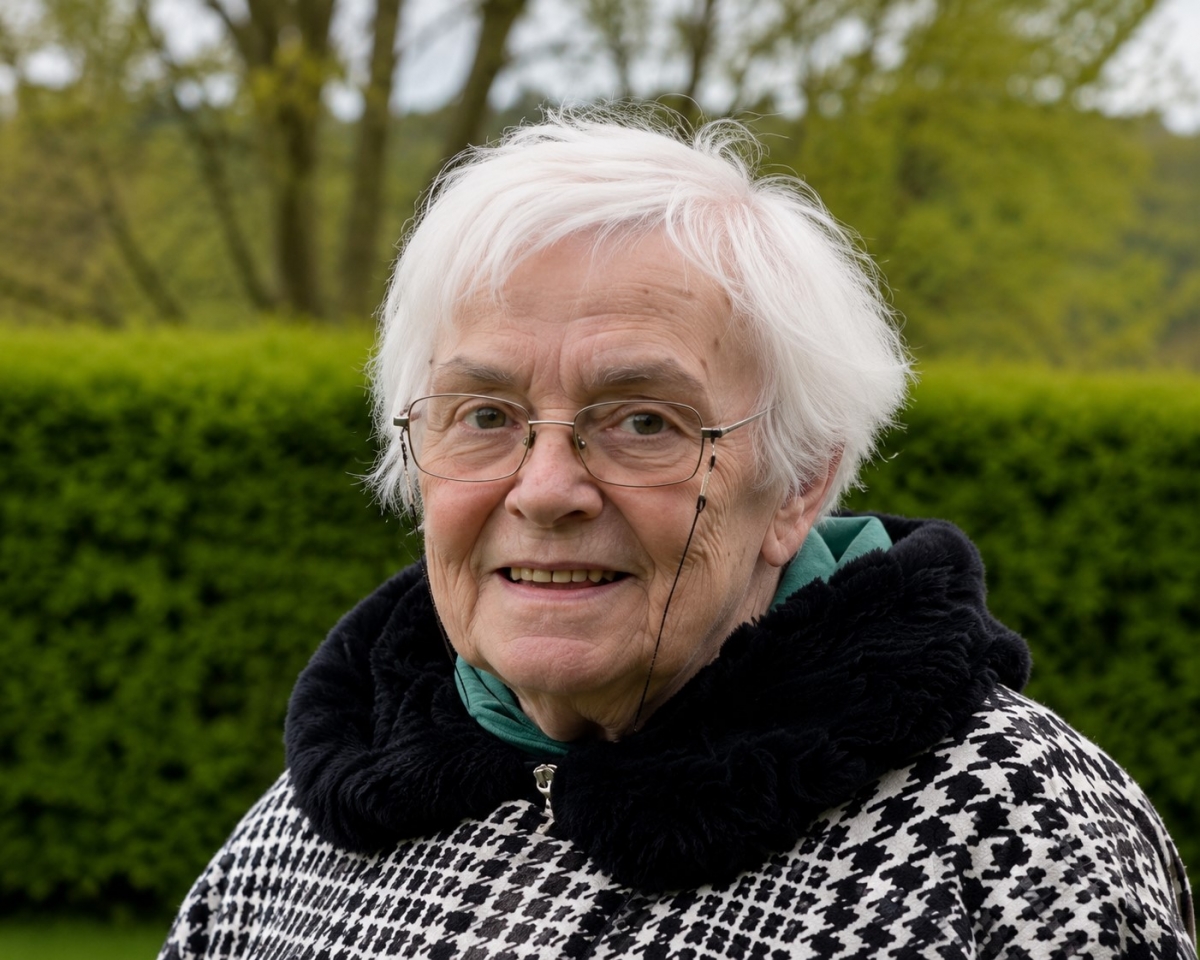
Everyone affiliated with the Wilfred Owen Association was saddened to learn of the passing of long-term committee member Meg Crane earlier this year. Meg was a highly-valued colleague and friend to many; she made a significant and lasting contribution to the association’s work since its beginning. As well as serving as Journal Editor for a number of years, Meg also previously held the position of Chair. She will be fondly remembered by all on the current committee as we continue the work of the organisation in the years to come.
Since her passing, the committee has been touched to receive messages from the membership to share their own memories and reflections of Meg. With the kind permission of one of her friends, Merryn Williams, we are able to share the below:
“I’ve known Meg on and off for years. We first met in Shrewsbury, but I’d heard of her before that, when a controversial poem of hers (about an Irish rebel) was shortlisted in the National Poetry Competition. Bits of her life emerged as I got to know her better - a Liberal, a lapsed Catholic, studied at St Anne’s College, Oxford in an age when few women were accepted by the ancient universities, lived in Durham with her husband and son but got divorced, taught English in schools while working long and hard for the WOA in her limited spare time.
"She was always funny, always well-informed, a delight to work alongside. We were possibly the only two people on earth who were fascinated by a) the poetry of Wilfred Owen and b) the famous Chalet School series (which about half of educated women in England read when they were girls). Meg was a fine poet. She wasn’t widely published, but she helped me judge a 1914 competition, ‘In the Spirit of Wilfred Owen’, and contributed two poems to the WOA’s anthology of the same name.
"Meg’s prose was good, too. There was a time in her life when, like me, she enjoyed writing Chalet School spin-offs, aimed at adults rather than children – an unmarried schoolmistress between the wars, a woman who joined the Nazi Party. I dig out these stories, published in little magazines years ago, and reflect that she was actually a better writer than several well-known novelists. She couldn’t have been an ambitious person. She was qualified to be a well-known figure in the literary world, but instead gave her talents to the Wilfred Owen Association, and to teaching. How sad I am that we can’t have those conversations in lovely Shrewsbury again!”
The committee’s Membership Secretary, Thomas Muldoon, first began working with Meg in 2018 and shared the following:
“It was with great sadness that we learned of Meg Cranes passing on the 30th April, 2026. It also happened to be the day after Meg's birthday, which was celebrated surrounded by her family and loved ones, including her son Greg, his wife Jodie and their two older children. Also Meg's sister Siobhan.
“As a member of the Wilfred Owen Association from its inception, Meg played crucial roles including those of Chair and also many years as Editor of the Journal. Many members of the WOA and the Siegfried Sassoon Fellowship will have fond memories of Meg during events and key celebrations over many years. Meg was a dear friend and colleague who gave invaluable service as a member of the WOA Committee. Her thoughtful presence, erudition and wisdom were unsurpassed.
“During Meg's funeral service we learned from a moving eulogy given by Meg's sister Siobhan, that Meg had attended Oxford University and went on to become a school teacher. We also heard about her high academic achievements and dedication to literature. From the messages of condolence received both in the UK and abroad, it is clear that Meg was held by those who knew her, in high esteem and gratitude for her dedication and service. Our thoughts and prayers are with all her family at this sad time.”
The committee would also like to thank Merryn Williams for sharing the below poem, written by Meg, for the 2002 poetry anthology titled: ’In the Spirit of Wilfred Owen’.
A DRAWING DOWN OF BLINDS
(Monkmoor Road, Shrewsbury)
There are thousands, perhaps millions of such houses:
raw redbrick, trimmed with washed-out hydrangeas;
in every town they line Victorian roads
above the railway. The streets beyond are newer:
the roof lines lower. This row must have looked,
in his time, unhindered to Wenlock and the Wrekin.
From black Birkenhead, from desperate shabby-genteel
pretentious poverty, they came to this
clean drowsy town, where Wilfred every evening
sat at his desk in the bay of the attic window,
in the suburban twilight, and thought that nothing
would ever happen.
A few months of the noise,
the responsibility, the limbs in shellholes,
were enough to happen. Weep, you may weep, for you
may touch them not. Twilight showed up the corpses
lying in the hollows of the Hampshire downs;
and through a window in Scarborough sent a whisper:
A voice I know, and this time I must go.
Weep, you may weep, for you ... on Armistice Day
the telegraph boy biked up with his envelope, and
the unwilling blinds were drawn as bells swung wildly
among the vanes of Shrewsbury, and each slow dusk
that settled on the street came drifting gently
through the attic window, hoping to find him there.
As well as the thoughts and recollections of both Merryn and Thomas, the association is grateful to Meg’s son, Greg, for his permission to share the following obituary which was initially written for the Siegfried Sassoon Fellowship. Meg will continue to be remembered in an upcoming edition of the journal.
Margaret Mary Claire Crane
29th April 1947 to 30th April 2026
Meg was born on 29th April 1947 in Berkhamsted, the first daughter of Alec and Eve Begley, both teachers.
In 1953 she was joined by her sister Siobhan and they grew up in the south London suburb of Streatham Hill. Meg’s most vivid recollections of childhood revolved around holidays spent in Ireland and Glasgow with her father Alec’s formidable mother Granny Begley; a figure of family legend and dreadnought will. Somewhat more restful holidays were spent with Eve’s parents in Berkhamsted.
Meg and Siobhan both attended La Retraite, a Catholic school for girls in nearby Clapham, and aged 18 Meg won a scholarship to read English at St. Anne’s College Oxford. From what I gather this was an event of sufficient rarity that either the entire school or part of it (accounts differ!) was given the day off in celebration; a contribution to the collective happiness of the student body remembered to this very day by Meg's school friends.
Whilst at Oxford Meg met my father David and following her graduation they married in 1969, moving to Durham where David had taken up a position as Lecturer at the University's English Department. I was born in 1970 and dampened down my mother's more intellectual activities for a time.
In the early ‘seventies Meg took B.Litt and in 1977 M.A at Newcastle University and the following year decided to take up teaching, enduring rather than enjoying a PGCE course at Durham University’s School of Education. Her first job was a baptism of fire in one of County Durham’s toughest comprehensive schools.
During this time Meg also turned her hand to both radio drama and writing, producing a number of plays for Radio 4 under both her own name and the pen name Margaret Gillard. She also turned her early teaching experiences into a novel, "The Spires as they are seen from the Railway”, later published by Bodley Head; a story about an embattled teacher in a struggling school encouraging a pupil to gain a place at Oxford University. In later years it became something of a running gag between Meg and myself that the annual Public Lending Right payments for the novel were spent buying a single small glass of wine once a year.
In 1984 Meg, frustrated with the rather narrow horizons of County Durham’s schools, secured a postion at St Leonard’s Mayfield, an independent Girls’ school in Sussex. Naturally this meant that she had to live within a reasonable distance of her work and she moved, initially for term-times only, to Tunbridge Wells in Kent. In practice the move marked the end of my parent’s marriage and David and Meg divorced amicably in 1988.
Meg left Mayfield in the early 2000s and began a more peripatetic phase of her working life, teaching at a number of schools on a series of short-term contracts and maternity covers. The original plan had been that this 'semi-retirement' would afford more time for her to pursue travel and literary interests. The travel part of this plan worked out quite well, with a number of ambitious trips to Eastern Europe, Ukraine and Russia, areas whose history and culture had always held a profound fascination for her. However with the exception of her work with the Wilfred Owen Association and the Siegfried Sassoon Fellowship - labours of love from which she drew great satisfaction - the 'free time' she had been looking forward to devoting to writing seemed to be forever receding into the future.
Meg unfortunately seemed to inherit her health from her father’s side of the family rather than her more robust mother’s - her maternal grandmother and aunt both lived to be over 100. In her sixties Meg developed mobility issues which, only irksome at first, steadily reduced her horizons. Throughout these trials and the occasional hospitalisation my mother retained a stolid and good-humoured stoicism; enjoying the right to grumble yet never owning up to frustration or bitterness.
Following a stroke in 2024 and a further lengthy hospitalisation the next year Meg decided to move to Leicester in order to be closer to her beloved sister Siobhan. Unfortunately this was not to be. Following a fall over the Christmas holiday Meg elected to spend some time in a residential care home whilst ‘working up’ to moving in to her new flat in Oadby. Meg suffered a second stroke on the afternoon of her 79th birthday whilst sitting in the garden of the care home enjoying the unseasonal sunshine with Siobhan, myself and her grandaughter Olivia. She died in the small hours of the following morning with us by her bedside. She was quiet and in no pain or distress and I held her hand as she left us.
An obituary is such a small space in which to frame a life, particularly when the author is kin to the subject. The events and achievements which mark our passage to the outside world seem less important than the countless more profound and trivial occurrences with which our families more properly and fully measure our days. I'm doubtless not the first to find difficulty remembering dates and events in a parent's life which were of significance to her and the outside world but which, with the blithe selfishness of a child were to me merely minor distractions from her role in my life as Mum.
Meg would often visit me, my wife Jodie and our children Olivia and Jonathan on the way to and from conferences, events, festivals and jobs. Each arrival was marked with presents for the children, flowers for the house and wine for the adults, and on almost all her visits we would talk into the small hours of both great events and small happenings, conversations which were always free-range and fascinating, high brow and low humour. On more than a few occasions we talked the entire night away.
Meg's death was swift and dignified and although we will now have no more of those conversations I am grateful that she was spared any debility which would have diminished her keen intellect and interests, or her pleasure in good company.
I shall miss her forever.
- Greg Crane
Top image credit: Thomas Muldoon